"Press 1 for sales. Press 2 for support. Press 3 to speak to an operator who will ask you to press 1 or 2 again." We've all been there. Then came chatbots, promising to revolutionize customer interaction. Instead, they mostly just automated frustration.
But something shifted in 2024-2025. Conversational AI stopped being a glorified decision tree and started understanding context, nuance, and intent. Organizations that implement it properly are seeing first-contact resolution rates above 70%, customer satisfaction improvements of 30-40%, and support cost reductions exceeding 50%.
The difference between conversational AI that frustrates and conversational AI that delights comes down to one thing: does it solve the customer's problem, or does it just deflect to a human faster?
Why Traditional Chatbots Failed
Walk into most businesses in 2023 and you'd find a chatbot. Ask it anything beyond its scripted responses and you'd get:
- "I'm sorry, I didn't understand that."
- "Let me connect you with a human agent."
- "Please rephrase your question."

The leap from scripted responses to genuine understanding transformed conversational AI effectiveness
These rule-based systems failed because they couldn't:
- Understand context: Each message treated as independent, no conversation memory
- Handle variations: "I need to update my address" vs "My address changed" triggered different (or no) responses
- Resolve complex issues: Anything requiring multiple steps or system access hit dead ends
- Learn from interactions: Same mistakes repeated indefinitely
Result: customers hated them, agents were overwhelmed with escalations, and ROI calculations looked embarrassing. Many organizations quietly disabled their chatbots and pretended the project never happened.
What Changed: The LLM Revolution
Large Language Models (LLMs) fundamentally changed what's possible with conversational AI. Instead of matching keywords to canned responses, modern conversational AI:
- Understands intent regardless of phrasing
- Maintains context across multi-turn conversations
- Accesses multiple systems to gather information and take actions
- Handles ambiguity and asks clarifying questions
- Adapts responses to customer tone and urgency
But—and this is critical—LLMs alone don't solve the problem. You need architecture, integration, and guardrails. That's where most implementations still fail.
The Four Pillars of Effective Conversational AI
After implementing conversational AI across customer service, sales, IT support, and HR functions, four pillars consistently separate success from failure:
Pillar 1: Context Management
Effective conversational AI remembers and reasons about:
- Conversation history: Everything said in the current conversation
- Customer history: Previous interactions, purchases, issues, preferences
- System context: Current account status, order status, service status
- Business rules: Policies, approval limits, escalation triggers
A telecommunications company implemented context-aware conversational AI for billing inquiries. When a customer says "Why is my bill higher this month?", the AI:
- Retrieves the current bill and previous bill
- Identifies differences (international calls, equipment charges, etc.)
- Explains the difference in natural language
- Offers relevant actions (dispute charge, update plan, set spending alerts)
First-contact resolution went from 23% with the old chatbot to 68% with context-aware AI.
Pillar 2: Action Capability
Conversation without action is just sophisticated deflection. Your conversational AI needs to actually do things:
- Update customer records
- Process refunds and credits
- Schedule appointments or services
- Create support tickets with full context
- Trigger workflows in backend systems
🔧 Integration Architecture Matters
Your conversational AI is only as capable as the systems it can access. API integration, proper authentication, and transaction handling are not optional—they're the foundation of effectiveness.
An e-commerce company gave their conversational AI the ability to process returns end-to-end. Customer says "I want to return this item," and the AI:
- Verifies the purchase and return window
- Generates a prepaid return label
- Initiates the refund process
- Emails confirmation and tracking
Result: 82% of returns processed entirely through conversation, with customer satisfaction scores exceeding human-handled returns.
Pillar 3: Intelligent Routing
Some issues genuinely require human expertise. The key is routing intelligently:
- Issue complexity: Escalate when the problem exceeds AI capability
- Customer emotion: Detect frustration and offer human assistance proactively
- Value-based routing: High-value customers get faster paths to specialized agents
- Context preservation: When routing to human, provide full conversation context
A financial services firm implemented sentiment-aware routing. When the AI detects negative sentiment above a threshold (angry language, repeated requests, escalation keywords), it:
- Acknowledges the customer's frustration
- Offers immediate connection to a specialist (not general support)
- Provides the specialist with conversation history, customer value tier, and issue summary
Customer satisfaction for escalated issues improved 45% compared to the old "transferred to random available agent" approach.
Pillar 4: Continuous Learning
Static conversational AI becomes obsolete quickly. Build in learning mechanisms:
- Analyze conversations where the AI failed to resolve issues
- Identify new question patterns and add training data
- Monitor success metrics by conversation type
- A/B test different response strategies
- Incorporate feedback from customers and agents
A SaaS company runs weekly reviews of their conversational AI performance. They identify the top 10 conversation types where human escalation was necessary, analyze why, and either:
- Add training data to improve AI responses
- Integrate additional systems to enable resolution
- Create workflows for the AI to trigger
- Accept that human expertise is needed and optimize the handoff
Over six months, their AI resolution rate improved from 52% to 71% through continuous learning.
Use Cases Beyond Customer Service
Most conversational AI discussion focuses on customer service. But the technology delivers value across business functions:
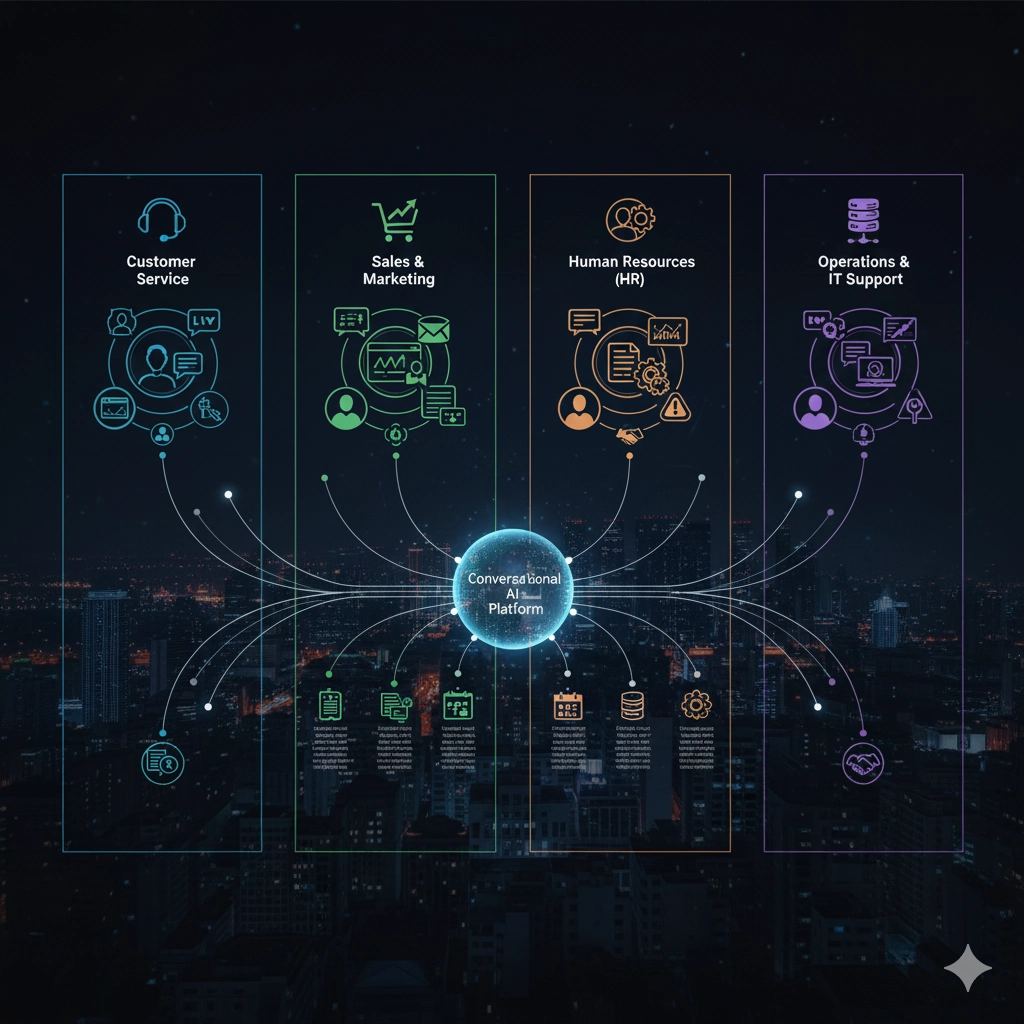
Conversational AI creates value wherever human-to-system interaction creates friction
Sales Qualification and Lead Engagement
Conversational AI on your website that actually qualifies leads:
- Asks discovery questions to understand needs
- Recommends relevant products or services
- Schedules demos with appropriate sales reps
- Provides immediate quotes for standard configurations
A B2B software company saw lead-to-opportunity conversion increase 34% by deploying conversational AI that qualified intent before routing to sales.
IT Help Desk and Employee Support
Internal conversational AI for common IT and HR requests:
- Password resets and access requests
- Software installation and troubleshooting
- PTO requests and HR policy questions
- Expense report issues and approvals
A 2,000-employee company reduced IT help desk tickets by 60% with conversational AI handling common requests. IT team refocused on strategic projects instead of password resets.
Internal Knowledge Management
Conversational AI as a natural language interface to company knowledge:
- Answer questions about policies, procedures, products
- Find relevant documentation without keyword searches
- Summarize information from multiple sources
- Keep answers current as documentation evolves
A professional services firm deployed conversational AI for internal knowledge. New employees became productive 40% faster because they could ask questions in natural language instead of navigating complex documentation systems.
Proactive Customer Engagement
Instead of waiting for customers to initiate contact, use conversational AI proactively:
- Order updates and delivery notifications with option to modify
- Renewal reminders with ability to renew via conversation
- Usage alerts with recommendations to optimize value
- Upsell opportunities based on behavior patterns
An insurance company used proactive conversational AI to reach out before policy renewals. Customers could ask questions, update coverage, and renew through conversation. Renewal rate increased 22%.
Implementation: What Actually Works
After implementing conversational AI across various organizations, certain patterns consistently lead to success:
Start Narrow, Then Expand
Don't try to handle all customer interactions day one. Pick one high-volume, well-defined use case:
- Order status inquiries
- Password resets
- Appointment scheduling
- Balance and payment inquiries
Get that working well, then expand scope based on what you learn.
Design for Graceful Failure
Your conversational AI will encounter situations it can't handle. Design those moments carefully:
- Recognize when confidence is low and offer human handoff proactively
- Never loop—if the AI doesn't understand after 2-3 attempts, escalate
- Provide clear escalation paths ("Would you like to speak with a specialist?")
- Log all failures for continuous improvement
⚠️ The Confidence Threshold
Set a confidence threshold below which the AI offers human assistance. Too high (95%+) and you'll over-escalate. Too low (60%) and you'll frustrate customers. Start at 75-80% and tune based on outcomes.
Invest in Integration
The limiting factor in conversational AI effectiveness is usually not the AI—it's the integration with backend systems. Budget accordingly:
- API development for system access
- Authentication and security implementation
- Transaction handling and rollback capabilities
- Real-time data synchronization
A retail company spent 70% of their conversational AI budget on integration and only 30% on the AI platform itself. Result: 80%+ resolution rate because the AI could actually complete transactions.
Measure What Matters
Track metrics that reflect business outcomes, not just AI performance:
- First-contact resolution rate: Did the customer's issue get solved without escalation?
- Customer satisfaction: NPS/CSAT for AI-handled interactions
- Time to resolution: How quickly were issues resolved?
- Deflection rate: What percentage of contacts never reached human agents?
- Cost per interaction: Total cost divided by conversations handled
The Human-AI Partnership
The best implementations don't replace humans—they create powerful human-AI partnerships:
- AI handles volume: Routine, repetitive inquiries that follow predictable patterns
- Humans handle complexity: Edge cases, emotional situations, judgment calls that require empathy
- AI supports humans: Provides agents with context, suggests responses, automates follow-up
- Humans train AI: Agent feedback and corrections improve AI performance over time
A healthcare organization deployed conversational AI for appointment scheduling and general inquiries. Medical questions and complex cases immediately route to nurses. Result: nurses spend time on healthcare instead of scheduling, while patients get instant responses for routine requests.
Common Pitfalls and How to Avoid Them
🚫 Implementation Mistakes
- Overpromising capability: Don't claim your AI can do things it can't. Customers remember broken promises.
- Hiding the escalation path: Make it easy to reach a human when needed. Forcing customers to "work around" the AI creates resentment.
- Ignoring conversation design: Natural conversation flow requires deliberate design. LLMs don't automatically create good experiences.
- Insufficient testing: Test with real customers before launch. Edge cases will surprise you.
- Set-and-forget mentality: Conversational AI requires ongoing monitoring, tuning, and improvement.
Looking Forward
Conversational AI has crossed the threshold from "interesting technology" to "practical business tool." Organizations implementing it properly see measurable improvements in customer satisfaction, operational efficiency, and employee productivity.
The key is moving beyond the chatbot mentality—beyond simple question-and-answer exchanges—to genuine conversation that understands context, takes action, and solves problems.
Start with a narrow, well-defined use case. Build the integration to make it actually useful. Design for graceful failure. Measure business outcomes. Improve continuously based on what you learn.
That's how you move beyond the chatbot hype to conversational AI that customers actually appreciate—and that delivers real business value.