Artificial intelligence and automation are at a turning point. Not because of breakthrough announcements or speculative promises, but because the technology has matured to where it's reshaping how organizations operate, how people work, and how society approaches questions of risk and governance.
The shift is subtle but significant. We've moved past the question of whether AI can be useful to grappling with how to deploy it responsibly at scale. The focus has turned from capabilities to consequences—from what's technically possible to what's practically sensible.
The most important AI developments in 2026 aren't about raw performance. They're about deployment, control, and the societal systems we build around these technologies.
Agentic AI & Autonomous Systems
The defining characteristic of 2026's AI landscape is the rise of agentic AI—systems that don't just respond to prompts but actively pursue goals, make decisions, and take actions across multiple steps without constant human direction.
This represents a fundamental shift from AI as an answering machine to AI as an active participant in workflows. Where earlier systems required humans to break down tasks and guide each step, agentic AI can interpret high-level objectives and determine the sequence of actions needed to achieve them.

Agentic AI operates autonomously across multiple steps and decision points
Real Business Use Cases
Organizations are deploying agentic AI in areas where decision-making previously required human judgment:
- Customer Service Operations: AI agents that don't just answer questions but diagnose issues, access relevant systems, execute solutions, and follow up—handling complete resolution workflows independently
- Supply Chain Management: Systems that monitor inventory, predict demand fluctuations, automatically adjust orders, and reroute shipments in response to disruptions
- Financial Operations: Agents that review transactions, flag anomalies, investigate discrepancies across multiple systems, and propose or execute corrective actions
- Software Development: Tools that analyze requirements, design architectures, generate code, create tests, and deploy updates with minimal human involvement in the execution phase
The shift from "AI answers questions" to "AI accomplishes objectives" changes the ROI calculation dramatically. When a system can complete an entire process rather than just assist with parts of it, efficiency gains compound.
💡 The Agentic Difference
Traditional AI: "What's the status of order #12345?"
Agentic AI: "Resolve the delivery delay for order #12345"—and the system checks status, contacts the
carrier, adjusts the route, notifies the customer, and updates all relevant systems without further
prompting.
Enterprise Automation & Hyperautomation
The concept of hyperautomation—automating not just individual tasks but entire business processes end-to-end—has moved from buzzword to operational reality. Organizations are connecting AI with robotic process automation (RPA), workflow engines, and integration platforms to create seamless automated operations.
Traditional RPA struggled with variability. If a document format changed or a system interface updated, automation broke. AI-powered hyperautomation handles these variations because the underlying models understand context rather than following brittle rules.
Automation Across Departments
The impact spans every business function:
- Human Resources: From resume screening through onboarding, performance management, and offboarding—entire employee lifecycle processes running with AI coordination
- Finance & Accounting: Invoice processing, expense management, financial close, reporting, and compliance documentation generated and verified automatically
- IT Operations: Incident detection, diagnosis, remediation, and prevention handled by AI agents that monitor systems, apply fixes, and learn from outcomes
- Sales & Marketing: Lead qualification, personalized outreach, proposal generation, contract review, and deal progression managed by coordinated AI workflows
The Efficiency and Scalability Question
The business case for hyperautomation centers on three factors: speed, consistency, and scalability. Automated processes run faster than manual ones. They produce consistent outputs regardless of volume. And they scale without linear increases in cost or headcount.
Organizations implementing hyperautomation report being able to handle 2-3x the transaction volume with the same team size, or redirect significant portions of their workforce from operational execution to strategic initiatives.
Impact on Work & Productivity
The conversation around AI and jobs has evolved from "will AI replace workers?" to "how do we manage the transition as AI transforms work?" The evidence from 2025-2026 suggests a more nuanced reality than either utopian or dystopian predictions.
Job Transformation vs Job Displacement
Certain tasks are being automated entirely. Data entry, basic document processing, routine scheduling, simple customer inquiries—these are increasingly handled by AI systems. But complete job elimination has been less common than job transformation.
What's happening instead: roles are being redefined. Customer service representatives focus on complex issues requiring empathy and creativity while AI handles routine requests. Financial analysts spend less time gathering data and more time interpreting trends and advising stakeholders. Software developers shift from writing boilerplate code to designing systems and reviewing AI-generated implementations.
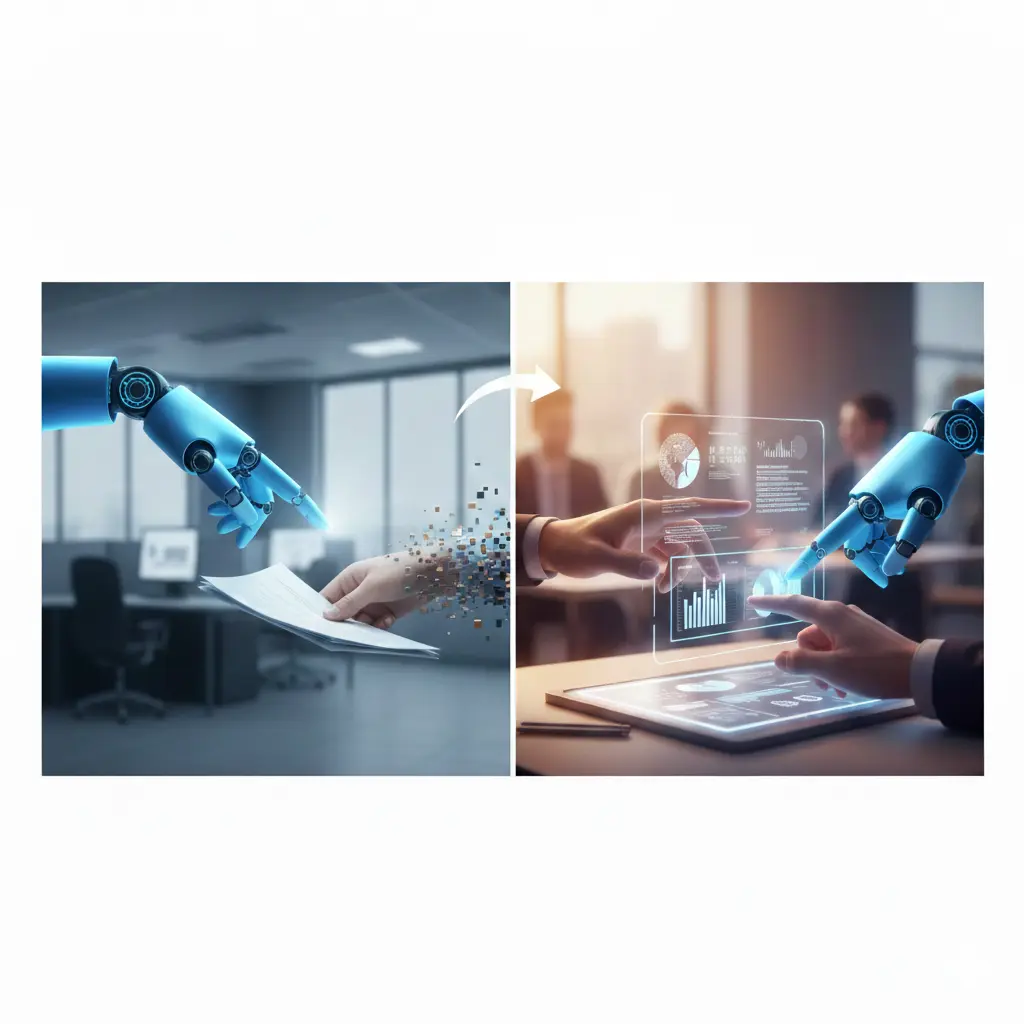
The future of work centers on effective human-AI collaboration
New Roles Created by AI
AI adoption is creating demand for new skillsets and roles that didn't exist a few years ago:
- AI Orchestration Specialists: Professionals who design and manage multi-agent workflows
- AI Governance Officers: Roles focused on ensuring AI systems operate within ethical and regulatory boundaries
- Prompt Engineers: Experts in crafting effective instructions and configurations for AI systems
- AI Quality Auditors: Specialists who evaluate AI outputs for accuracy, bias, and compliance
- Human-AI Interaction Designers: Professionals who create intuitive interfaces between people and AI systems
The Reskilling Imperative
The most critical factor in managing this transition is reskilling. Organizations that invest in training their workforce to work effectively with AI systems report higher productivity gains and better employee retention than those that don't.
The skills in demand aren't just technical. Critical thinking, complex problem-solving, emotional intelligence, and creative reasoning remain distinctly human capabilities that AI complements rather than replaces.
The most successful organizations treat AI adoption as a workforce development challenge, not just a technology implementation.
AI Safety, Governance, and Regulation
As AI systems gain autonomy and influence over consequential decisions, concerns about risk, control, and accountability have intensified. The conversation has shifted from theoretical dangers to practical governance.
Corporate Governance Takes Center Stage
Leading organizations are establishing internal governance frameworks that go beyond compliance checkboxes. These frameworks typically include:
- AI Ethics Boards: Cross-functional teams that review high-impact AI deployments and ensure alignment with organizational values
- Model Risk Management: Processes for evaluating AI system risks before deployment and monitoring performance over time
- Explainability Requirements: Standards for documenting how AI systems make decisions, particularly in regulated industries
- Bias Detection and Mitigation: Regular audits to identify and address discriminatory patterns in AI outputs
- Human Oversight Protocols: Clear rules about when humans must review or approve AI decisions
Regulatory Landscape
Governments worldwide are implementing AI-specific regulations. The European Union's AI Act, which took effect in phases through 2025-2026, establishes risk-based requirements. High-risk AI systems face stringent testing, documentation, and monitoring obligations. The United States has adopted a sector-specific approach, with different agencies regulating AI in healthcare, finance, employment, and other domains.
This regulatory activity creates compliance obligations but also provides clarity. Organizations know what's expected, which enables more confident investment in AI systems that meet established standards.
⚠️ Why Responsible AI Matters Now
AI systems deployed without adequate governance create reputational, legal, and financial risks. Biased hiring algorithms, discriminatory lending systems, or AI decisions that can't be explained when challenged—these aren't hypothetical concerns. They're generating lawsuits, regulatory penalties, and erosion of trust. Responsible AI practices are risk management, not optional extras.
Cutting-Edge Research & What's Next
Beyond current deployments, several research directions are showing practical promise:
Multi-Agent Systems
Research into AI agents that coordinate with each other to accomplish complex objectives is moving from labs to production environments. Rather than a single AI handling everything, specialized agents collaborate—one focused on data retrieval, another on analysis, a third on execution, with an orchestrator managing their interactions.
This architecture improves reliability (failures are isolated to specific agents rather than breaking entire systems) and enables more sophisticated capabilities than monolithic AI approaches.
Embodied AI and Robotics
AI is increasingly integrated with physical systems. Warehouse robots that adapt to changing layouts, agricultural systems that identify and respond to individual plant needs, manufacturing equipment that adjusts processes based on real-time quality data—the combination of AI decision-making with physical automation is expanding rapidly.
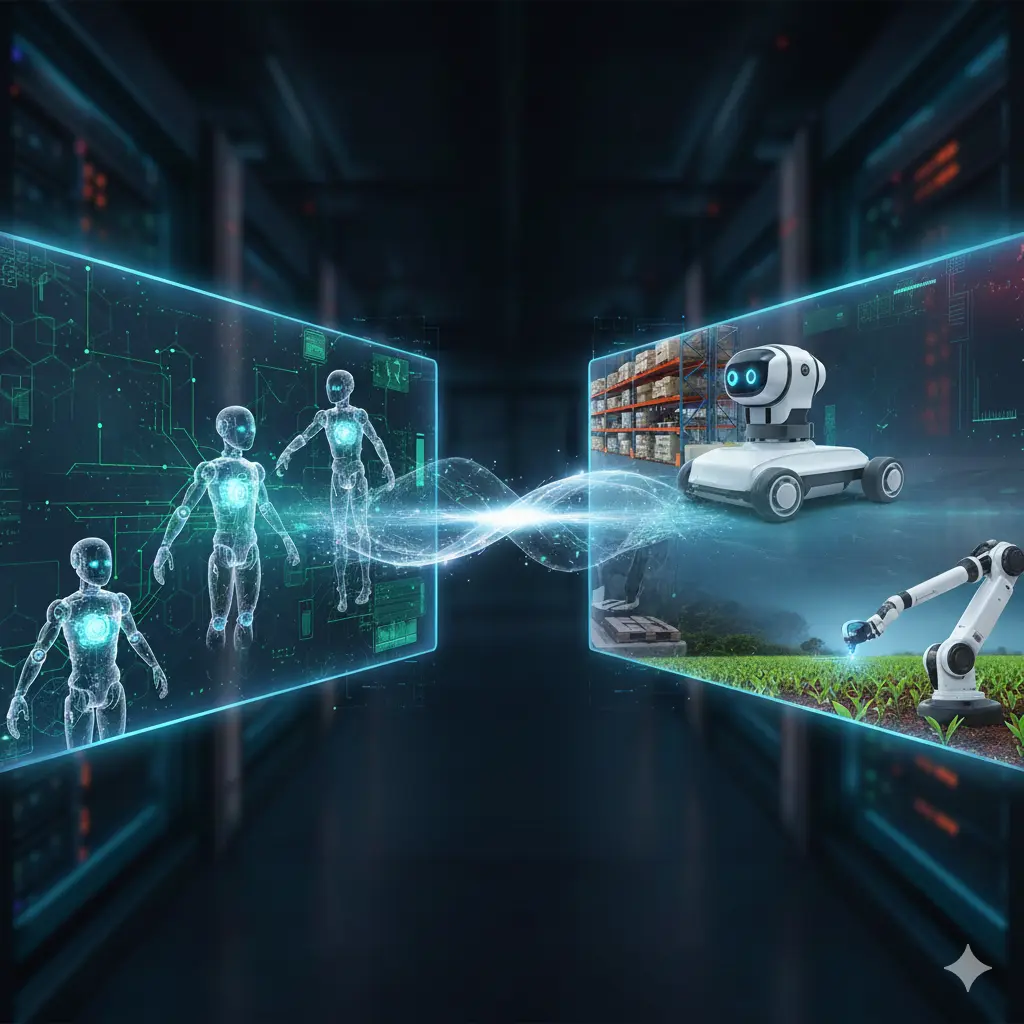
Embodied AI combines intelligent decision-making with physical automation
Practical Implications
These advances mean organizations need to think beyond software. AI strategy increasingly includes physical infrastructure, sensor networks, and systems integration. The boundary between digital and physical operations is blurring.
Looking Forward: Opportunities and Challenges
AI and automation in 2026 present clear opportunities: efficiency gains, enhanced capabilities, new products and services. Organizations that deploy these technologies effectively can operate at scales and speeds that weren't previously possible.
The challenges are equally clear: managing workforce transitions, ensuring systems operate fairly and safely, navigating regulatory requirements, and maintaining human oversight of increasingly autonomous systems.
The organizations succeeding in this environment share common characteristics:
- They approach AI as a capability to be integrated thoughtfully, not a silver bullet
- They invest in governance and risk management from the start, not as afterthoughts
- They treat workforce development as central to their AI strategy
- They measure success by business outcomes, not technology adoption metrics
- They maintain human accountability for AI decisions, particularly in high-stakes scenarios
The question for 2026 and beyond isn't whether AI will transform work and business—it's whether organizations will manage that transformation deliberately or react to it reactively.
The technology exists. The business case is proven in many contexts. The remaining variables are human: leadership decisions about deployment priorities, investment in people alongside investment in systems, and the discipline to implement AI responsibly rather than recklessly.
Those who navigate these variables well will find significant competitive advantage. Those who don't will face the consequences of poorly governed, hastily deployed systems that create more problems than they solve.
The trends shaping AI and automation in 2026 aren't just technological. They're organizational, social, and political. Understanding this broader context is essential for anyone working with or affected by these systems—which increasingly means everyone.