After years of hype, AI automation is finally delivering measurable business value. The difference in 2025? Organizations have stopped asking "what can AI do?" and started asking "what business problem will this solve?"
The shift is significant. Enterprise AI automation is no longer about flashy demos or proof-of-concepts that never make it to production. It's about systems that reduce costs, improve accuracy, and scale operations in ways traditional automation never could.
The most successful AI automation initiatives in 2025 share one characteristic: they solve specific, measurable business problems rather than chasing technology for its own sake.
From RPA to Intelligent Automation
Traditional Robotic Process Automation (RPA) had a good run. It excelled at repetitive, rules-based tasks—clicking through forms, copying data between systems, processing structured documents. But it hit a wall when faced with anything requiring judgment, understanding context, or handling unstructured data.
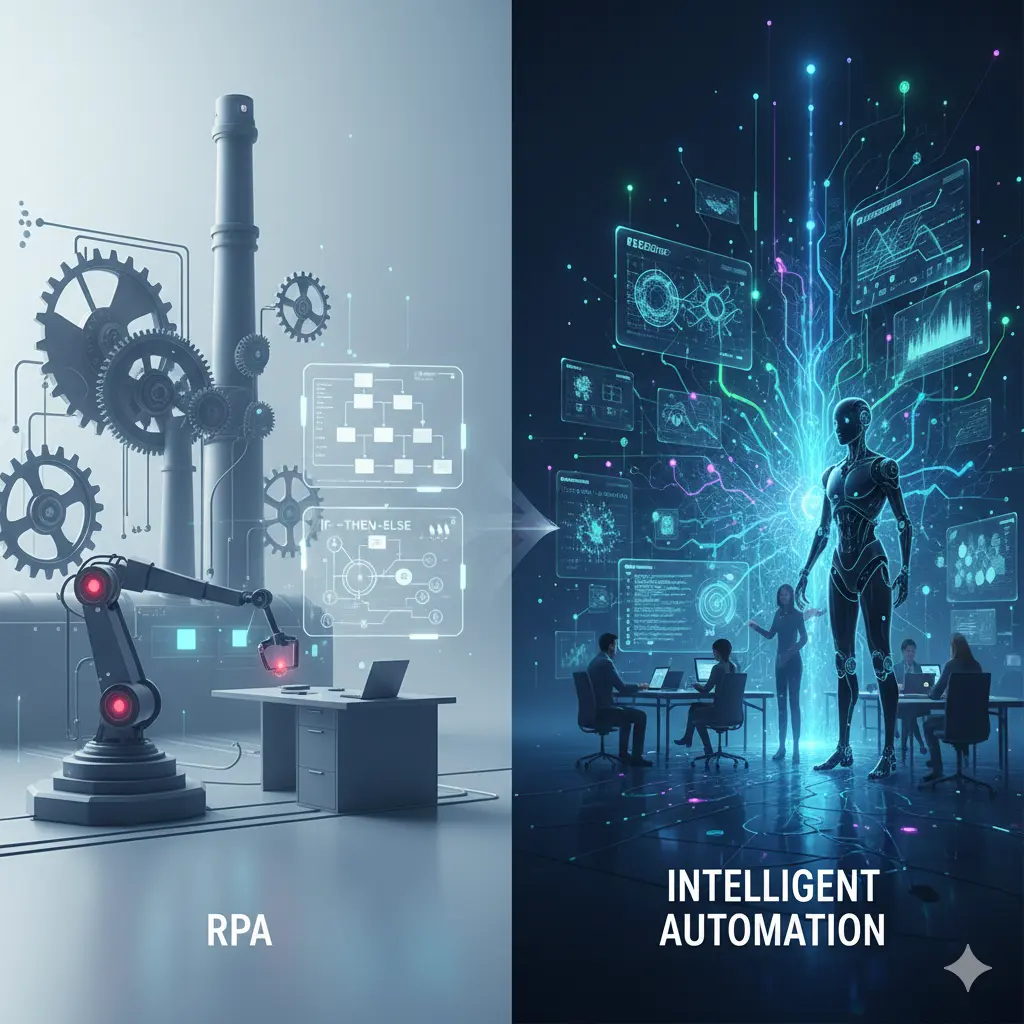
The evolution from rule-based RPA to AI-driven intelligent automation
AI changes this equation fundamentally. Modern intelligent automation combines traditional RPA with:
- Natural Language Processing: Understanding emails, contracts, and customer requests without rigid templates
- Computer Vision: Processing documents regardless of format or structure
- Decision Intelligence: Making context-aware choices based on historical data and business rules
- Continuous Learning: Improving accuracy over time as it processes more data
The practical impact is immediate. Tasks that previously required human review—invoice processing with inconsistent formats, customer service ticket routing, compliance document analysis—now run end-to-end with minimal intervention.
The Rise of AI Agents in Business Processes
Perhaps the most significant trend of 2025 is the emergence of AI agents—autonomous systems that don't just execute tasks but actively manage entire workflows. Unlike traditional automation that follows predetermined paths, AI agents make decisions, adapt to changing conditions, and coordinate with other systems.
💡 What Makes an AI Agent Different?
Traditional automation: "If X happens, do Y."
AI agent: "Here's the goal. I'll figure out the best way to achieve it given current conditions."
Real-world applications are already delivering results:
- Procurement Agents: Monitor supplier performance, identify cost-saving opportunities, and automatically renegotiate contracts based on market conditions and historical data
- Customer Service Agents: Handle multi-turn conversations, access multiple data sources, escalate complex issues, and learn from successful resolutions
- Financial Reconciliation Agents: Identify discrepancies across systems, investigate root causes, and propose corrections while flagging anomalies for human review
- Compliance Agents: Monitor regulatory changes, assess impact on business processes, and automatically update procedures and documentation
These aren't theoretical use cases. Organizations are deploying these agents now, measuring their impact in hours saved, errors reduced, and opportunities identified that humans simply didn't have time to pursue.
The Copilot Pattern Goes Enterprise
The "copilot" pattern—AI working alongside humans rather than replacing them—has evolved from a developer tool concept to an enterprise-wide strategy. The insight is simple: AI doesn't need to automate 100% of a process to deliver massive value.
Smart organizations in 2025 are implementing AI copilots across core business functions:
- Finance Copilots: Draft financial reports, flag unusual transactions, suggest budget optimizations
- Legal Copilots: Review contracts, identify risks, suggest standard clauses based on company policy
- Sales Copilots: Analyze customer interactions, suggest next actions, draft personalized follow-ups
- HR Copilots: Screen resumes, schedule interviews, draft job descriptions aligned with company standards
The key insight: these copilots handle the 80% that's routine, freeing professionals to focus on the 20% that requires expertise, judgment, or relationship-building. Productivity improvements of 30-50% are common when the implementation is done thoughtfully.
Document Intelligence at Scale
Enterprise document processing has transformed dramatically. Organizations deal with millions of documents—contracts, invoices, reports, forms, emails—in countless formats and structures. Traditional OCR and template-based extraction never quite worked for the messy reality of business documents.
Modern AI document processing is different. Large language models can:
- Extract key information regardless of document format or structure
- Understand context and relationships between data points
- Identify anomalies and potential errors automatically
- Classify and route documents without predefined rules
- Summarize lengthy documents while preserving critical details
The business impact is substantial. One financial services firm reduced invoice processing time from 48 hours to 2 hours. A legal department cut contract review time by 60%. An insurance company automated 70% of claims document processing that previously required manual review.
The Infrastructure Question
As AI automation moves from pilot projects to production deployment, organizations are grappling with a new set of infrastructure challenges. The successful implementations share common patterns:
Organizations that succeed treat AI automation as a platform capability, not a series of disconnected projects. They build:
- Centralized prompt libraries and guardrails
- Standardized evaluation and monitoring frameworks
- Clear governance for model selection and deployment
- Reusable integration patterns for common data sources
What Actually Works: Lessons from the Field
After reviewing dozens of enterprise AI automation implementations, certain patterns separate successful deployments from failed experiments:
✓ Success Patterns
- Start with high-volume, well-defined processes that have clear success metrics
- Involve process owners from day one—they know where the real pain points are
- Build human review workflows for edge cases rather than trying to automate everything
- Measure business outcomes (time saved, errors reduced, revenue impact) not technical metrics
- Treat AI as a component in a larger system, not a magic solution
The organizations seeing the best results aren't necessarily using the most advanced AI. They're using AI that's appropriate for their specific problems, integrated thoughtfully into existing workflows, and measured against clear business objectives.
Looking Forward
AI automation in late 2025 is less about technology limitations and more about organizational readiness. The tools exist. The models are capable. The integration patterns are proven.
The question for most organizations isn't "can we automate this with AI?" but rather "have we prepared our processes, data, and people for AI-driven automation?" The answer to that question determines success far more than model selection or technical architecture.
The winners in this space will be organizations that treat AI automation as a strategic capability—investing in the infrastructure, governance, and organizational change required to deploy it effectively at scale. Because the competitive advantage doesn't come from having access to AI. Everyone has that now. It comes from deploying it faster, more reliably, and with better business outcomes than your competitors.